 Defilama
 yields for comparing pool APY and TVL
Defilama yields brings together DeFi pool rates and historical APY and TVL data for comparing yield opportunities. Earn, Borrow, Loop, and Reference Rates separate different questions about returns and borrowing. A useful comparison keeps the pool, network, and observation period consistent before treating a rate as a decision input.
Earn, Borrow, Loop, and Reference Rates separate different rate questions
Earn compares pool yields, Borrow compares lending-market borrowing rates, and Loop compares leveraged lending strategies. A supply APY alone doesn't establish the net return of a position that also borrows. Looping combines supplied and borrowed exposure, so both sides affect the outcome. Reference Rates weights stablecoin supply and borrow base rates by market size across the largest EVM lending markets. It excludes reward APY, so compare it with a matching base-rate component.
Compare earnings rates with earnings rates, and borrowing rates with borrowing rates. Shared percentage units don't make their economic meanings identical.
Themes narrow the pool comparison without changing pool identity
Stables, Majors, Commodities, Liquid Staking, Safe Haven, and High Yield organize the Earn view by theme. Those groupings narrow the subject of a comparison. Within each theme, underlying assets, network, and protocol define a pool's exposure. An asset symbol alone leaves those distinctions unresolved. Keep that context intact when narrowing a ranking or reading a historical series, so the comparison continues to concern the intended pool.
What do APY and TVL measure in a pool ranking?
APY expresses an annualized yield, while TVL measures the value of assets tracked in a pool. A comparison by APY orders rate estimates. A comparison by TVL orders tracked capital. Both numbers describe a pool, with different units and economic meanings.
APY's annual basis
APY means annual percentage yield. It expresses a yield on an annual basis; the pool's calculation determines the compounding assumptions behind the quoted figure. Automatic reinvestment is a separate property of the pool's mechanism. Where a breakdown is available, base APY comes from fees or supplying, while reward APY comes from token incentives.
Rate changes during a position
The applicable rates can change during a holding period. Reading the pool's historical series makes that variation visible. A current quote describes the latest rate observation; earlier observations belong to their own times. An average also needs the period over which it was calculated.
Asset value and the amount received
A return measured in tokens can differ from a return measured in currency when asset prices change. Realized proceeds also reflect the cost of executing the exit and any applicable pool charges. The quoted yield and the final amount received therefore require different inputs.
TVL's valuation basis
TVL means total value locked. Changes in tracked value can reflect changing asset prices, changing token quantities, or both. For lending pools, TVL is supplied value minus borrowed value in USD, so borrowing can also change it. Separating those contributions requires information beyond the aggregate value.
Pool history gives rate changes their time context
The pool-history API provides historical APY and TVL for an identified pool. Earlier observations show whether a quoted rate resembles the pool's past behavior or marks a recent departure. The comparison needs consistent pool identity and a common observation window. An annualized percentage from one point shouldn't be compared with an average from another period as though both describe the same interval. Available start and end observations also limit how much history the series can demonstrate.
Reading APY beside TVL can reveal a changing relationship between rates and tracked capital. A rising rate alongside falling TVL describes a pattern, but those series don't establish its cause. Depending on the pool's mechanism, borrowing demand, trading activity, or incentives may affect its return.
Verified APY records a simulated withdrawal
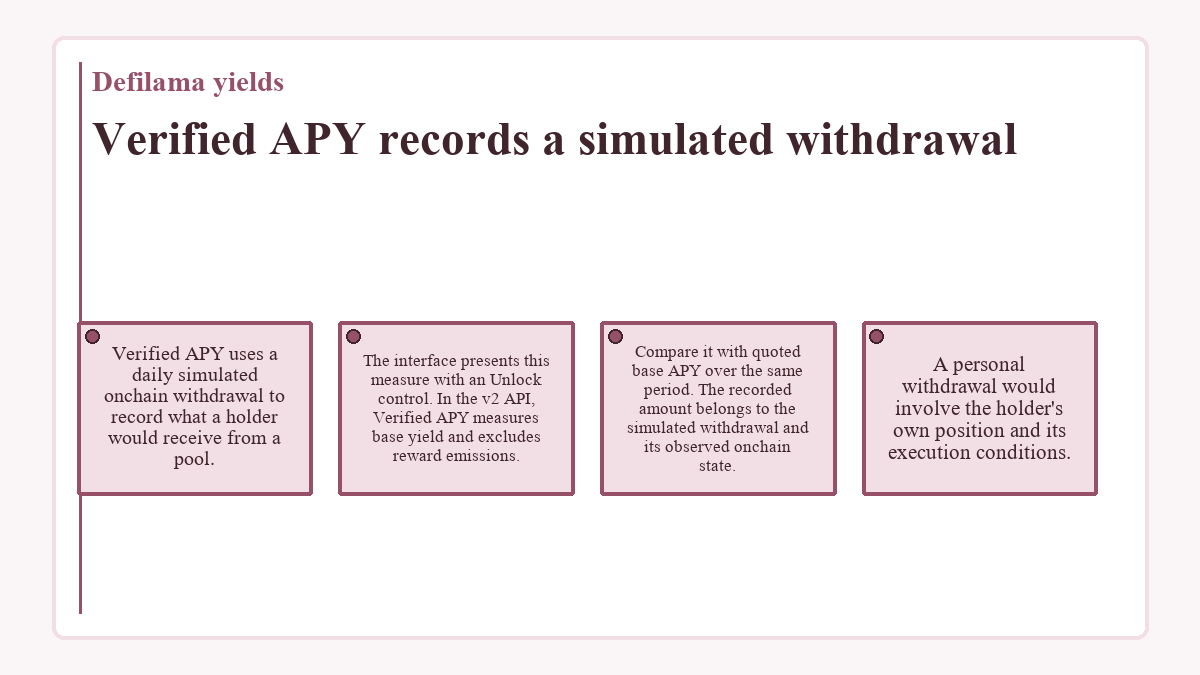
Verified APY uses a daily simulated onchain withdrawal to record what a holder would receive from a pool. The interface presents this measure with an Unlock control. In the v2 API, Verified APY measures base yield and excludes reward emissions. Compare it with quoted base APY over the same period. The recorded amount belongs to the simulated withdrawal and its observed onchain state. A personal withdrawal would involve the holder's own position and its execution conditions.
Does a high yield ranking establish pool safety?
A high position in a yield ranking doesn't establish a pool's security or available exit liquidity. The platform doesn't audit or endorse listed protocols. These limits apply to themed views as well, including Safe Haven.
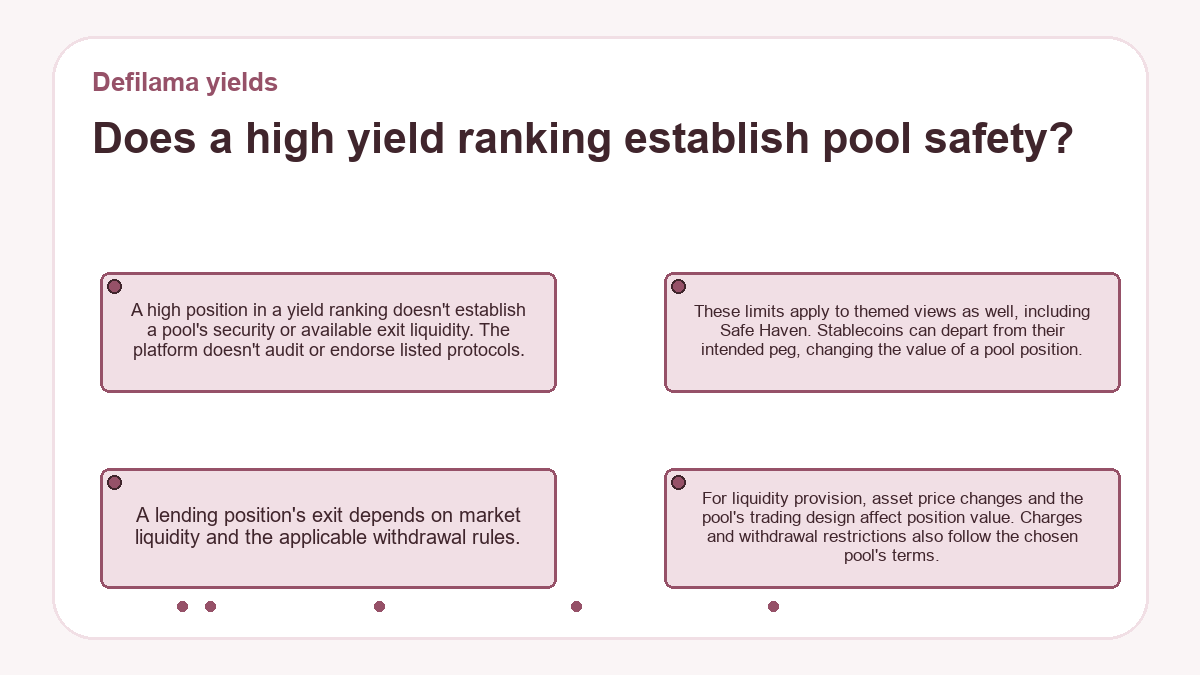
Stablecoins can depart from their intended peg, changing the value of a pool position. A lending position's exit depends on market liquidity and the applicable withdrawal rules. For liquidity provision, asset price changes and the pool's trading design affect position value. Charges and withdrawal restrictions also follow the chosen pool's terms.
A dated comparison of changing pool rates
In this hypothetical comparison, the same pool shows an earlier APY of 4.86% and a later APY of 6.16%. A reader wants to identify both observation times before continuing the research. The difference is 1.30 percentage points; it isn't the percentage return earned between readings.
If the earlier reading lacks an observation time, that difference can't describe a known interval. Keep the later reading and wait for the matching dated history. Another pool's series can't repair the gap, even when the displayed assets look similar.
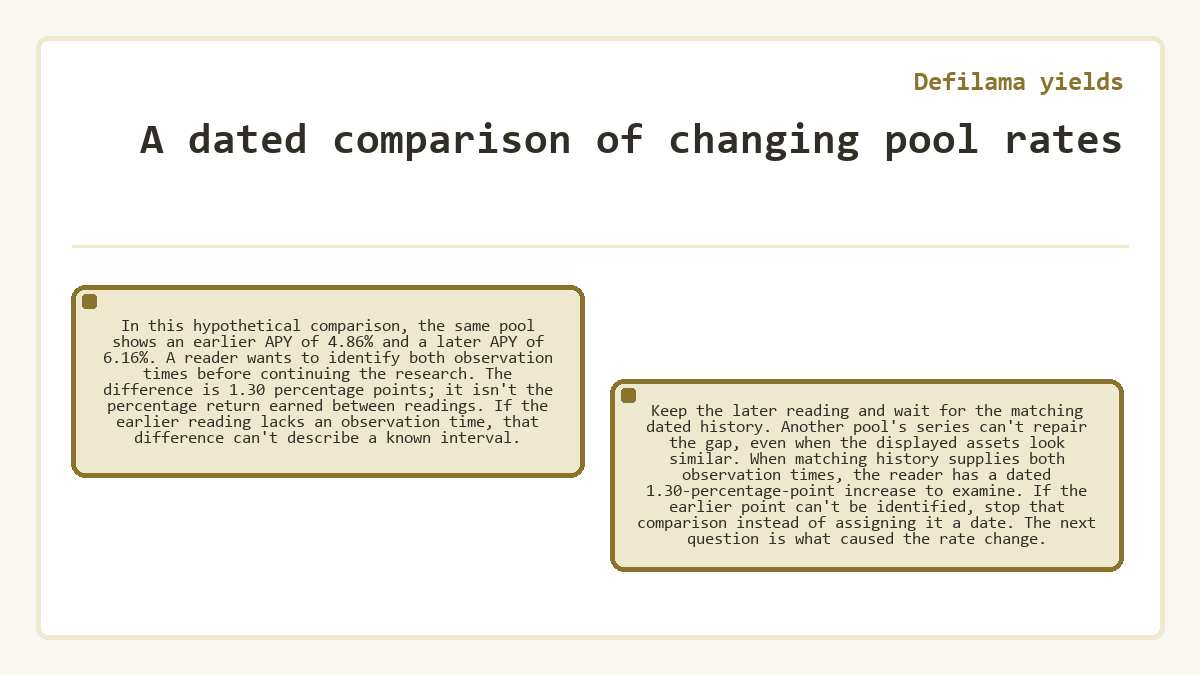
When matching history supplies both observation times, the reader has a dated 1.30-percentage-point increase to examine. If the earlier point can't be identified, stop that comparison instead of assigning it a date. The next question is what caused the rate change.
The yield API migration affects recurring comparisons
The legacy yield endpoints stop working on November 13, 2026. From that date, yield API access requires a paid API plan and key. Update affected integrations before the deadline.
A recurring dataset needs dated observations for the intended pool. Once a rate pattern is clear, the next decision concerns how that pool earns its yield and what its current exit terms allow.
Questions and answers
Does the free yield API require authentication?
The legacy free yield endpoints require no authentication until their scheduled shutdown on November 13, 2026. After that, yield API access requires a paid API plan and key. That access rule concerns data retrieval; an underlying pool can have its own participation or transaction requirements. Free access to a yield observation doesn't describe the cost of entering the pool.
Which identifier selects a pool's historical APY?
The pool-history request uses the pool ID exposed by the pool-list response. Legacy and v1 pool lists use the field pool; v2 uses id for the same identifier. This is a pool-specific identifier; the protocol slug used for protocol-level TVL history belongs to a different kind of request.
Are pool-data predictions a substitute for observed APY history?
No. Legacy pool data can include forecasts; v1 compatibility routes return null for prediction fields. Historical APY records past observations. A forecast doesn't fill an absent historical point or establish the realized return of a position.
Is pool APY the same metric as protocol revenue?
Pool APY and protocol revenue use different measurement bases. Revenue is a protocol-level amount for a reporting period, while APY expresses an annualized yield rate. A revenue total alone doesn't establish the share payable to a pool position or that position's return on capital.
Will a simulated withdrawal establish exit capacity for every position size?
The simulation covers the simulated holder and the onchain state used for that test. Exit conditions can vary with position size or execution time. Verified APY describes that simulated outcome, rather than establishing that every holder can withdraw a particular amount simultaneously.
Can a stablecoin pool's TVL represent the stablecoin's total circulating supply?
Pool TVL measures the value tracked in the pool, while circulating supply counts the stablecoin units in circulation. Converting supply to a currency value still leaves different coverage: the asset as a whole and a particular pool. Pool TVL doesn't establish the stablecoin's supply across all networks.
How should an empty yield response affect an APY average?
An empty yield response supplies no APY observation for an average. Treating it as zero inserts a rate that the response didn't contain, which can change the calculated average. Report the period actually covered by the available observations, keeping missing data separate from measured zero rates.