 Defilama
 fees for premium analytics, API plans, and swaps
Defilama fees depend on the access plan, billing period, and API usage above the included allowance. Core analytics and free API endpoints cost nothing. Pro analytics costs $49 per month or $490 per year; the API plan costs $300 per month or $3000 per year. The API plan includes Pro features alongside additional datasets and higher limits. Monthly call volume can add usage charges. A yearly plan's monthly equivalent doesn't mean monthly billing. Fees displayed for tracked protocols describe those protocols' activity, while a swap's execution costs belong to a separate calculation.
Subscription charges and API usage units
The access budget starts with a subscription charge for the selected billing period, plus any chargeable API calls beyond the plan's included monthly volume. Subscription prices use dollars per month or year. API overage uses dollars per additional group of calls. A protocol fee total uses a different basis: economic activity during its reporting period. Combining those figures would mix the price of retrieving information with the amounts that the information describes.
Premium dashboard tools and programmatic data access also have different purchase requirements. An API, or application programming interface, lets software retrieve structured data. The required dataset and request volume determine whether free access covers that task.
Free access to core metrics
Free access covers core analytics and keyless API requests for protocol TVL, token prices, stablecoins, DEX volumes, and fee datasets. TVL means total value locked. Historical TVL and protocol breakdowns are also available through free endpoints, so a requirement for dated data doesn't automatically require payment. Free access can cover a recurring calculation when the necessary endpoint and its limits suit the task. A paid subscription becomes relevant when the required capability exceeds that scope.
Pro tools within the analytics subscription
Pro includes custom dashboards and columns, CSV downloads, DefiLlama Sheets, LlamaAI analysis, and premium LlamaFeed access. Premium API access requires the separate API plan. A dashboard and spreadsheet task can therefore have a lower subscription requirement than an integration that needs a paid endpoint.
The API plan's additional coverage
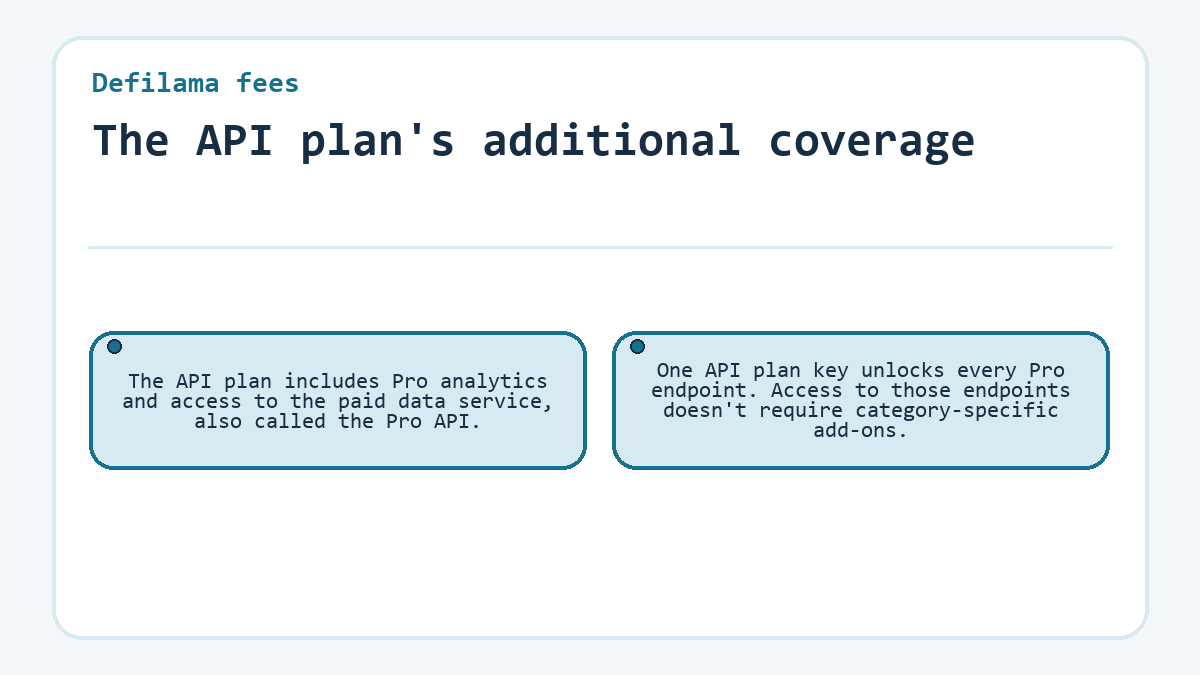
The API plan includes Pro analytics and access to the paid data service, also called the Pro API.
One API plan key unlocks every Pro endpoint. Access to those endpoints doesn't require category-specific add-ons.
Free datasets at higher limits
API plan key holders can retrieve free datasets through the paid service at higher rate limits. The service also uses mapped endpoint paths. Upgrading access therefore requires the appropriate request configuration, even when the underlying metric remains the same.
Protocol TVL and token prices
Paid mappings cover protocol TVL, its history, and token-price data. This route supplies higher limits for datasets that also have free access. The reason to pay can be retrieval capacity, without a requirement for an exclusive metric.
Stablecoins and pool histories
Stablecoin data and pool APY histories also have free-to-paid mappings. APY means annual percentage yield.
Additional datasets
Pro-only coverage includes dated protocol inflows and outflows, token unlock data, bridge datasets, and derivatives volume. Their availability doesn't make every related metric paid. Open-interest data has a free endpoint, while derivatives-volume endpoints sit within the paid service.
Historical observations also require the appropriate endpoint. Paying for the plan doesn't make a current-value response contain a time series. Matching the dataset to the question avoids buying broader access for information that an existing free history endpoint already supplies.
Annual prices and their monthly equivalents
The annual plans display monthly equivalents of approximately $40.83 for Pro and $250 for API access, tied to yearly payments of $490 and $3000. The annual payment covers twelve months. Month-to-month billing uses the higher monthly prices. Comparing the amount due with the period it covers prevents a monthly equivalent from being mistaken for a monthly payment.
Throughput limits, monthly calls, and overage
The standard API plan separates request throughput from included monthly usage: it lists 1000 requests per minute and 1,000,000 API calls per month. The per-minute limit governs request throughput. The monthly allowance specifies the included call volume. Neither number substitutes for the other, and an annual subscription still expresses its included call volume per month.
Calls beyond the included monthly volume carry a listed charge of $0.60 per 1000 additional calls. That price applies to excess calls, not the entire month's usage.
A budget therefore needs the base subscription and any applicable overage on the same time basis. Expected request frequency affects call volume even when the dataset stays unchanged. More frequent polling can consume the allowance faster without expanding the fields that an endpoint returns. The per-minute ceiling remains a separate operational constraint.
Protocol fee rankings describe activity
Dollar amounts in protocol fee rankings measure tracked activity over the selected reporting window, rather than subscription charges owed by the person viewing the ranking. The dashboard distinguishes fee data from revenue data and presents periods such as 24 hours, seven days, and thirty days. A large protocol fee total doesn't increase the price of retrieving that row. Access costs follow the selected plan and its usage terms.
The fee and revenue API includes free endpoints. Researching protocol charges therefore doesn't automatically require purchasing the API plan; the particular dataset and retrieval requirements remain the deciding factors.
LlamaSwap's fee policy and execution costs
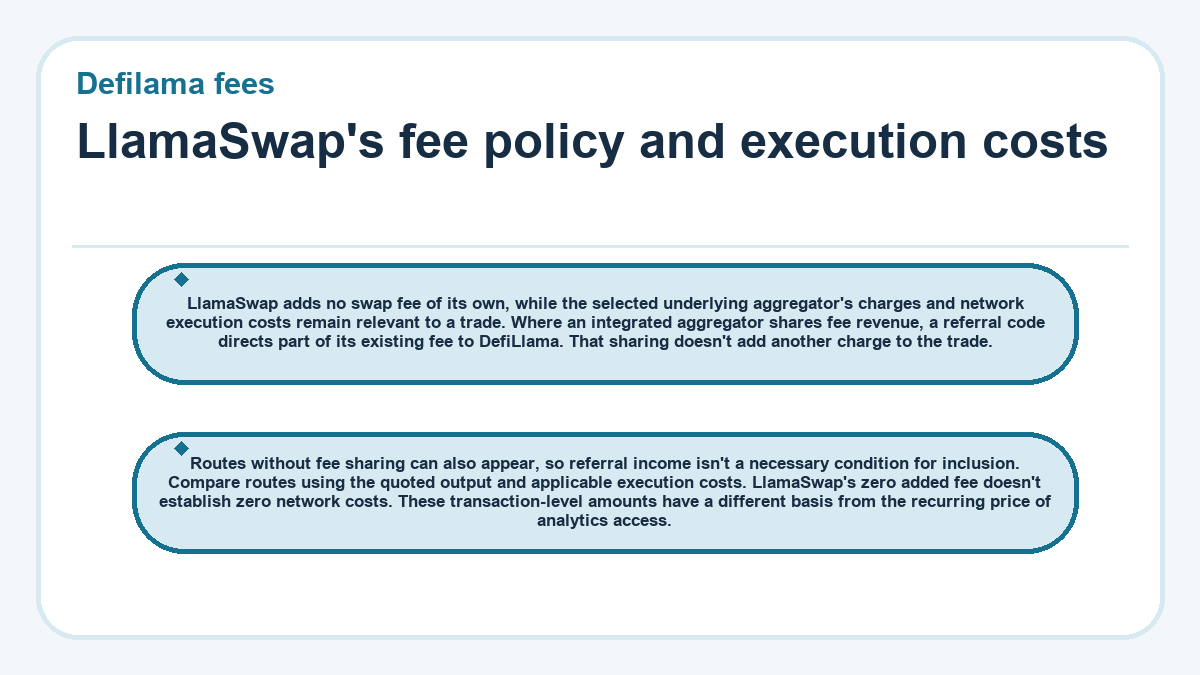
LlamaSwap adds no swap fee of its own, while the selected underlying aggregator's charges and network execution costs remain relevant to a trade. Where an integrated aggregator shares fee revenue, a referral code directs part of its existing fee to DefiLlama. That sharing doesn't add another charge to the trade. Routes without fee sharing can also appear, so referral income isn't a necessary condition for inclusion.
Compare routes using the quoted output and applicable execution costs. LlamaSwap's zero added fee doesn't establish zero network costs. These transaction-level amounts have a different basis from the recurring price of analytics access.
Does an API error mean the subscription has expired?
A 402 response from the free API doesn't establish subscription expiry; it identifies a request that needs the Pro service. An existing API subscriber can encounter this distinction without needing another subscription. The same data request sent through the correct paid service tests different access conditions from a request sent through the free service.
| Check in order | Access condition or result |
|---|---|
| Check the paid service and key placement | The key belongs in the request path, with the paid endpoint's mapped path. |
| Read the key's usage balance | The usage endpoint reports remaining credits. |
| Retry the required paid request | The response establishes whether that request retrieves the required data or still returns an error. |
| Purchase implication | Correcting request configuration can resolve an access problem under an existing subscription. |
Ordinary Pro data requests place the key between the service address and the endpoint, rather than in a header or query parameter. The usage endpoint handles it differently: the key goes at the end of that request's path. A successful usage response concerns the key's balance; the requested dataset still needs its own successful response.
The yield endpoint migration has a limited scope
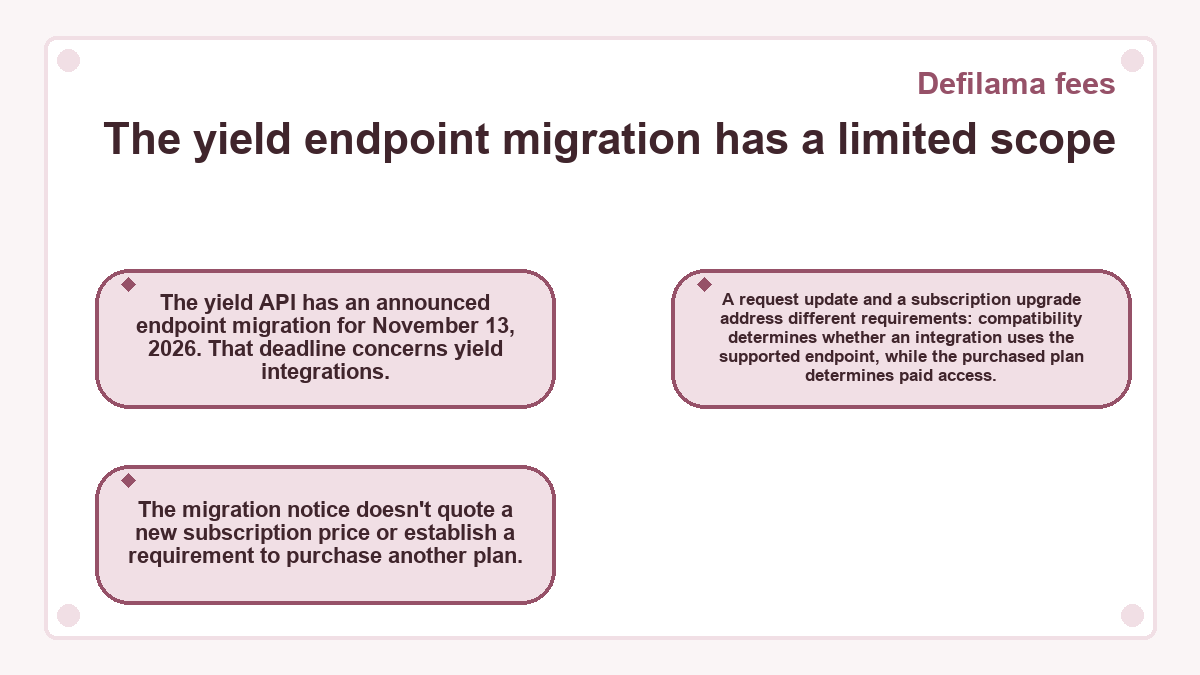
The yield API has an announced endpoint migration for November 13, 2026. That deadline concerns yield integrations. A request update and a subscription upgrade address different requirements: compatibility determines whether an integration uses the supported endpoint, while the purchased plan determines paid access. The migration notice doesn't quote a new subscription price or establish a requirement to purchase another plan.
Custom datasets versus standard access
Enterprise requires a custom quote for capabilities including direct database access, bespoke and hourly datasets, non-public token-address TVL breakdowns, custom licensing, and increased API limits. Its price follows the requested agreement. A standard API subscription price doesn't establish the cost of those additional requirements.
A listed Pro-only endpoint or higher standard request limits can make the API plan sufficient without a custom agreement. Dashboard customization and spreadsheet work can instead fit Pro analytics. When the required free endpoint already provides the data within its limits, that existing access remains the lower-cost alternative.
Defilama fees - common questions
What happens to paid access after a subscription is cancelled?
Paid access continues until the end of the billing period after cancellation. Cancellation is available through account settings.
Can a subscription be paid with cryptocurrency?
Subscriptions accept credit cards and cryptocurrency. Crypto payments cover monthly and yearly subscriptions on most major Ethereum Virtual Machine (EVM) chains; availability depends on the supported payment network.
When do the API key's remaining credits reset?
API key credits reset on the first day of each month. The usage endpoint reports the credits remaining for the supplied key. Its calendar-based reset and the per-minute request limit describe different usage constraints.
Is the seven-day Pro trial identical to paid Pro access?
The seven-day Pro trial excludes CSV downloads and has a limited research allowance. The trial offer converts to $49 per month afterward unless cancelled. It covers Pro analytics; premium API access requires the API plan.
Which borrowing-rate data belongs to the paid API?
Borrow-market cost APY and historical lending-market borrow-cost APY have Pro-only API endpoints. Those borrowing datasets differ from the free pool-history feed's historical APY and TVL. A calculation that needs borrowing costs requires the appropriate borrowing-rate data.